Macros for weight loss take three steps: take a deficit off your daily burn (TDEE), set protein in grams per kilogram of body weight and fat at about a quarter of calories, then give the rest to carbs. For a 30-year-old woman, 65 kg (143 lb), 165 cm (5 ft 5), who works out 1-3 times a week, the CalCash calculator gives 1,507 calories: 117 g protein, 40 g fat and 170 g carbs. Below is how those numbers come out and where each rule comes from.

1500 calories of chocolate vs 1500 calories of real food
You could technically hit your calorie target with nothing but candy bars and still lose weight. Calories decide whether the scale goes down. But in a deficit you lose some muscle along with the fat, and a diet of sweets tends to leave you hungry all day.
That's why there are macros: protein, fat and carbs, what your calories are actually made of. In the review by Leidy HJ et al., American Journal of Clinical Nutrition, 2015, people on higher-protein weight-loss diets lost more fat, kept more muscle and felt a little fuller after meals.
How to calculate macros for weight loss
Okay, here's the actual process. It's simpler than it looks. We'll use the same woman as an example: 30, 65 kg, 165 cm, light activity (1-3 workouts a week). All numbers come from our macro calculator.
Step one: calories. Her resting burn by the Mifflin-St Jeor formula is 1,370 calories; times 1.375 for light activity, her daily burn is 1,884. Losing about 1 lb (0.5 kg) a week means a 500-calorie daily deficit, the bottom of the "500 to 1,000 kcal/day" range in the NHLBI clinical guidelines, 1998. But the calculator never lets the deficit go past 20% of your burn; that cap is our own cautious choice, not a rule from a study. 20% of 1,884 is 377, so her target is 1,507 calories. Why bigger cuts backfire is explained in what a calorie deficit is.
Step two: protein. She trains, so the calculator uses 1.8 g per kg: 1.8 × 65 = 117 g, which is 468 calories (4 calories per gram). That's inside the 1.4-2.0 g per kg range the International Society of Sports Nutrition Position Stand, 2017 calls enough for most people who train, noting a deficit can push the need higher. If she didn't train, it would be 1.2 g per kg, the low end of the 1.2-1.6 range in the Leidy review.
Step three: fat. The calculator starts at 25% of calories, the middle of the 20-35% range in the US Institute of Medicine's Dietary Reference Intakes, 2005. 25% of 1,507 is 42 g. But that would leave carbs under 45% of calories, below the bottom of the same range, so the calculator trims fat to 40 g (360 calories at 9 per gram).
Step four: carbs get whatever's left, just like in the macro calculator. 1,507 minus 468 minus 360 is 679 calories, which is 170 grams of carbs.
Her macro split: 1,507 cal / 117 g protein / 40 g fat / 170 g carbs. Put your own stats into the calculator; yours will be different.
The same thing, straight from the calculator
Here's what the site's calculator gives the same woman if she doesn't train. Same engine as the calculator pages, not numbers anyone made up.
| Goal | Calories | Protein, g | Fat, g | Carbs, g |
|---|---|---|---|---|
| Weight loss | 1,315 | 78 g | 37 g | 168 g |
| Maintenance | 1,644 | 54 g | 46 g | 254 g |
| Gain | 1,809 | 91 g | 50 g | 249 g |
| Recomposition | 1,644 | 91 g | 46 g | 217 g |
Woman, 30, 65 kg, 165 cm, sedentary (×1.2), so protein is set for someone who doesn't train: 1.2 g/kg for weight loss, 0.83 for maintenance, 1.4 for gain and recomposition. Worked out with the macro calculator.
Two honest caveats so the numbers don't confuse you.
First, without training protein is much lower. At maintenance it's 54 g, the 0.83 g per kg adult requirement from the EFSA scientific opinion on protein, 2012. On a cut it's 78 g, 1.2 g per kg.
Second, the calculator caps the deficit here at 20% of her burn too: 1,315 calories instead of the 1,144 a flat 500 would give. That's about 0.3 kg (0.7 lb) a week. Slower, but no starving.
The men's version of this table, plus macro charts by weight in pounds, is in daily macro requirements for men and women. For your own stats, run the calculator. Don't just borrow the women's grams.
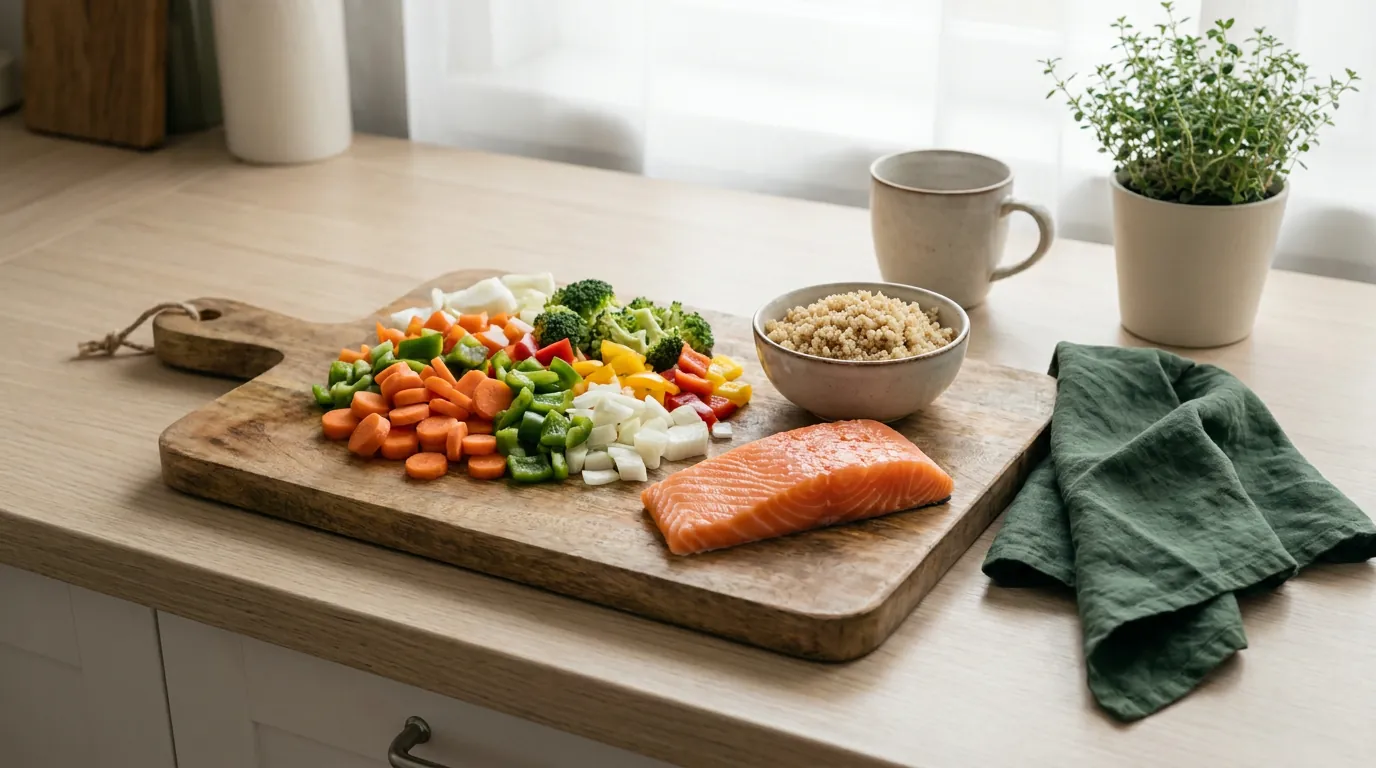
Why protein always comes first
In a deficit your body loses some muscle along with fat. Protein helps you keep it: that shows up in the meta-analyses in the Leidy review and in the ISSN position stand. The full breakdown by bodyweight and goal is here: how much protein per day.
And there's a bonus: people feel fuller after higher-protein meals, again per the Leidy review. To be fair, the authors call that effect modest, and in their studies it barely changed how much people ate at the next meal.
A real day at 1,500 calories
Nothing weird, nothing expensive. This day is built for the example above, 1,507 calories, 117 g protein, 40 g fat and 170 g carbs. Food values come from USDA FoodData Central.
| Meal | On the plate | Calories | Protein |
|---|---|---|---|
| Morning | Two eggs, 150 g (5 oz) of low-fat Greek yogurt, 40 g of rolled oats and a cucumber | about 420 | 33 g |
| Lunch | 120 g (4 oz) of cooked chicken breast, 70 g of brown rice (dry weight), a tomato and cucumber salad with a teaspoon of olive oil | about 530 | 44 g |
| Snack | A medium apple and 15 g of almonds, about a dozen | about 180 | 4 g |
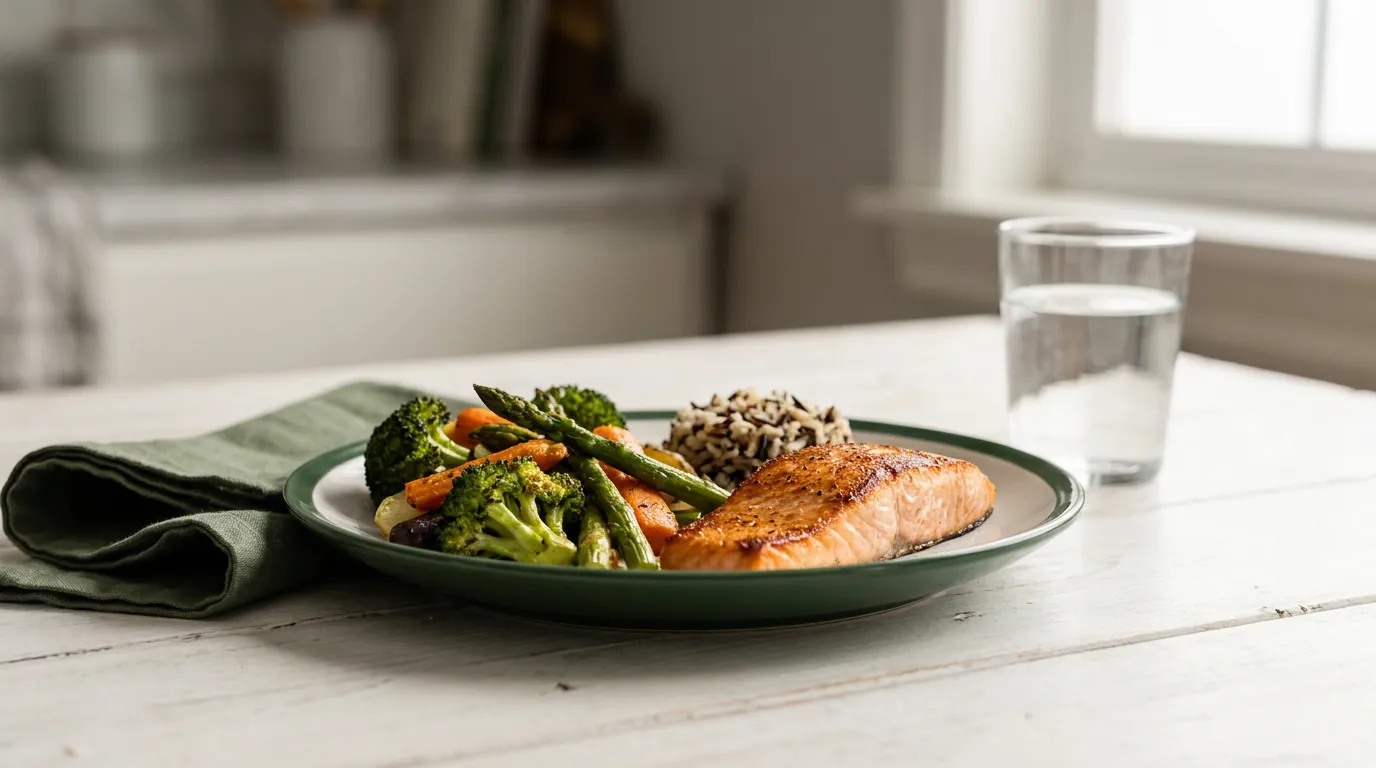
| Dinner | 120 g (4 oz) of baked pink salmon with 200 g of boiled mixed vegetables | about 310 | 35 g |
Total: roughly 1,450 calories, 116 grams protein, 41 grams fat, 153 grams carbs. That leaves about 60 calories for coffee with milk or a square of dark chocolate.
If you cook something more involved than chicken and rice — a stew, a casserole, a pot of soup — work out the calories of a homemade dish from its recipe, once per pot. For meals out there's a separate guide: how to count calories when eating out.
Not exciting. But sustainable, and that's the whole point.
The numbers people mess up
Three common macro mistakes.
Cutting fat too low. Your body needs fat for hormones and to absorb vitamins A, D, E and K. The Institute of Medicine range for adults is 20-35% of calories; the calculator holds 25% and only drops to 20% when carbs would otherwise run out of room. Type matters as well as amount: the WHO fact sheet on healthy diet, checked 19.10.2026 puts total fat at 30% of energy or less, saturated fat under 10% and trans fat under 1%, and says to limit free sugars.
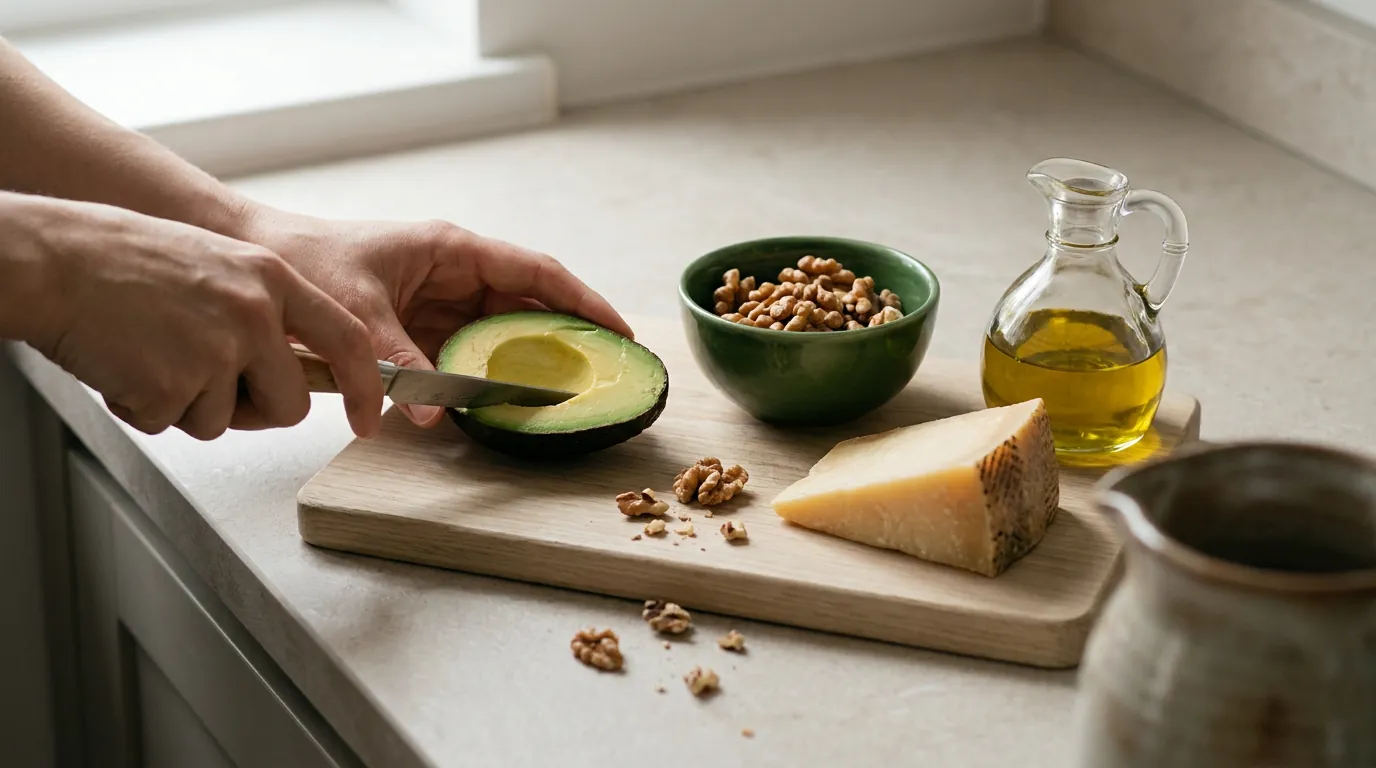
Fearing carbs. Carbs aren't the enemy. The Institute of Medicine sets the adult minimum at 130 grams a day and the healthy range at 45-65% of calories, and the calculator doesn't go below either.
Ignoring protein on "easy" days. Rest days, weekends, days when you don't work out. People eat less protein because "I didn't train so I don't need it." Your daily protein target is a daily target: ISSN talks about total daily intake spread across the day, not just on training days. Keep it consistent.
When the scale stops moving
It happens to everybody, and it's not a signal to halve your calories. Check three things first.
Has enough time passed? A flat week is noise — water, salt, hormones, what's in your gut. A real plateau is several weeks with no change in your weekly average; in practice people usually give it three.
Has your tracking drifted? After a month or two, portions creep up and entries get skipped. The most common reason a deficit "stops working" is that it quietly stopped being a deficit. One week of honest logging usually settles the question.
Is it time to recalculate? You're lighter, so you burn less. That's exactly where the deficit you set up at the start went.
If all three check out and the weight genuinely isn't moving, shave off a little more (studies don't give an exact step size) or add some activity (here's how many steps a day actually help). The full list of causes, in order, is in not losing weight on a calorie deficit? here's why. If you'd rather follow a day-by-day plan than a set of numbers, there's one here: a calorie deficit for weight loss, week one. Don't starve. And know that an occasional week at maintenance breaks nothing — it just keeps your head in the game.
You don't need to be exact
Seriously. Being off by 10-15 grams of protein on any given day won't ruin anything. What ruins things is consistency failure: tracking perfectly for three days, then not at all for a week.
That's what a calorie tracker that works inside Telegram is for: you just talk into the chat. "Had chicken with rice and a salad." Five seconds. You see the macro breakdown, check you're roughly in range, and move on. No weighing, no measuring cups. How that compares with the usual search-the-database trackers is covered in a look at calorie counter apps.
Even sloppy tracking beats no tracking. If your macros are in the right ballpark most days, you'll get results. Perfect macro hitting is for bodybuilders prepping for a show. The rest of us just need to be in the neighborhood.
So here's what to do
Put your stats into the calculator. It takes a deficit of up to 20% of your burn, sets protein by your goal and training, fat at about 25% and gives the rest to carbs.
Start logging today. Not perfectly, just roughly. After a week you'll know your patterns. After a month you'll have a clear picture of what you actually eat, which is the thing that makes everything else possible.


 Reminders
 Water and weight