Daily macro requirements are your maintenance calories split into protein, fat and carbs, and they scale with your body weight. For a 30-year-old, 200 lb man who's lightly active that comes to about 2,577 calories a day: 127 g protein, 72 g fat and 355 g carbs. A 150 lb woman of the same age and activity needs about 1,925 calories: 95 g protein, 53 g fat and 267 g carbs. Protein is set in grams per kilo of body weight, fat at a quarter of calories and carbs take the rest, exactly as in our macro calculator.
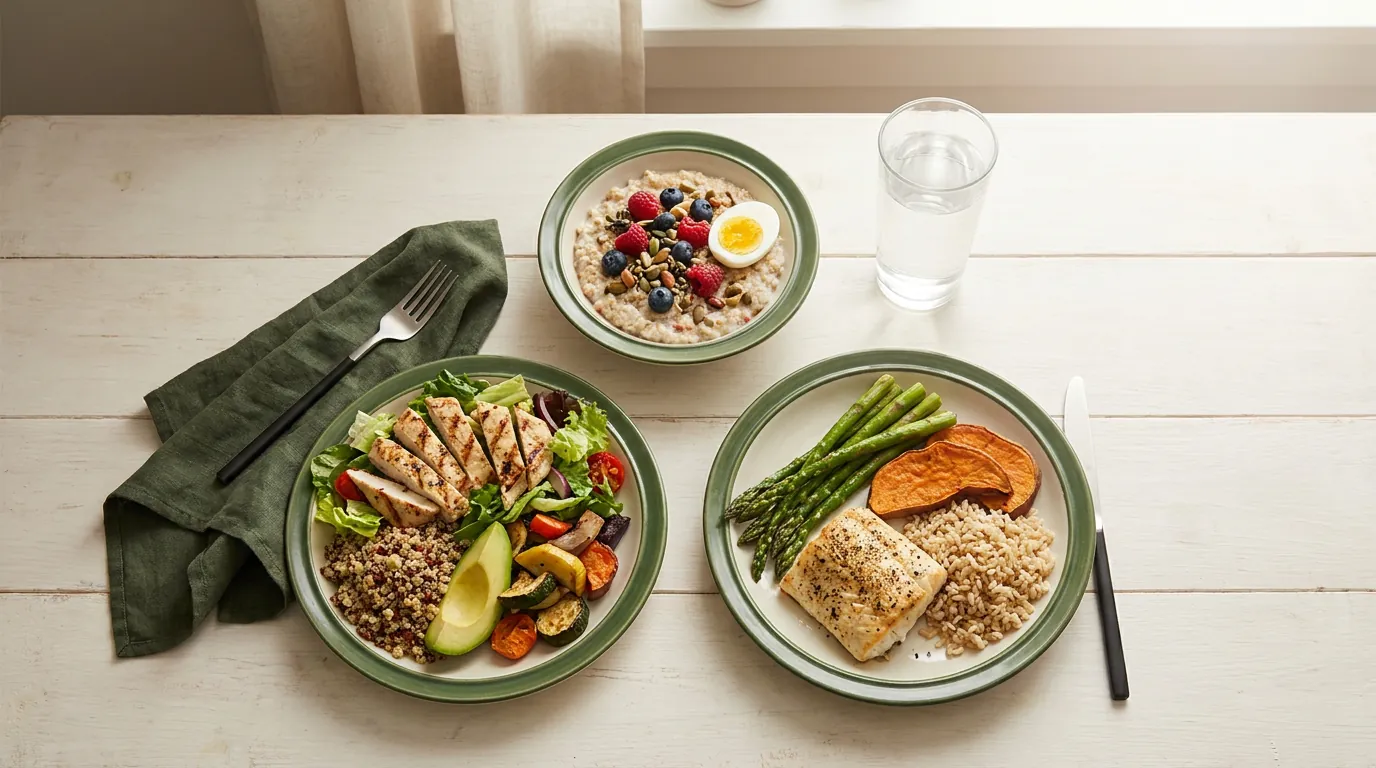
Below are macro charts by weight in pounds for men and women, the full 200 lb and 150 lb examples at every activity level, and the formula behind them, so you can find your own row in a few seconds.
The "2000 calorie" lie on every food label
You know that little line on the back of every cereal box and frozen pizza? "Based on a 2,000 calorie diet." That number exists so every label can work out its percentages from the same figure. It isn't anybody's actual requirement.
Take two 30-year-olds as an example. A 200 lb man, 5 ft 10, who trains 3-5 times a week burns about 2,905 calories a day by our calorie calculator. A 120 lb woman, 5 ft 5, with a desk job and no workouts burns about 1,517. That's almost double, and they're reading the same label.
So yeah, ignore the back of the box. Let's figure out your actual daily macro requirements.
One thing before the formulas: if you're not sure what weight you should even aim for, check your BMI first. It shows a healthy weight range for your height, and your weight goal decides whether you eat for a deficit, maintenance or a gain.
How to calculate your personal numbers
The Mifflin-St Jeor formula is your best bet here. When a systematic review in the Journal of the American Dietetic Association, 2005 compared the four equations everybody uses, Mifflin-St Jeor came out the most reliable — it landed within 10% of measured resting metabolic rate for more people than any of the others. The same review is honest about the catch: older adults and several ethnic groups were thin on the ground in the original studies, so the further you are from "average adult", the more you should trust your own scale over the formula.
Men: BMR = 10 times weight in kg + 6.25 times height in cm minus 5 times age plus 5
Women: BMR = 10 times weight in kg + 6.25 times height in cm minus 5 times age minus 161
The equation itself comes from Mifflin MD, St Jeor ST et al., American Journal of Clinical Nutrition, 1990, derived from 498 healthy adults aged 19 to 78, both normal-weight and obese.
BMR is your basal metabolic rate — what your body burns just lying in bed doing absolutely nothing. To get your actual daily needs, multiply by an activity factor:
- Desk job, no exercise: times 1.2
- Light workouts 1-3 days: times 1.375
- Moderate training 3-5 days: times 1.55
- Hard training 6-7 days: times 1.725
That whole "resting burn times an activity factor" idea comes from the FAO/WHO/UNU report Human energy requirements, chapter 5, 2004, which defines physical activity level and describes lifestyle categories from sedentary to vigorous.
Or just plug your stats into our macro calculator. Takes 30 seconds. And for how much to drink a day, there's the water intake calculator. To make the scale move, the CalCash calculator takes 250, 500 or 750 calories off that number, but never more than 20% of it — the mechanics of that are in what a calorie deficit is.

Daily macro chart by weight: men
Calories alone don't tell you what to put on the plate, so these charts go straight to grams. Find your weight, read across. Every number comes from the same engine that runs the calculator on this site.
| Weight | Calories | Protein | Fat | Carbs |
|---|---|---|---|---|
| 140 lb (63.5 kg) | 2,203 | 89 g | 61 g | 325 g |
| 160 lb (72.6 kg) | 2,329 | 102 g | 65 g | 334 g |
| 180 lb (81.6 kg) | 2,452 | 114 g | 68 g | 346 g |
| 200 lb (90.7 kg) | 2,577 | 127 g | 72 g | 355 g |
| 220 lb (99.8 kg) | 2,703 | 140 g | 75 g | 367 g |
| 240 lb (108.9 kg) | 2,828 | 152 g | 79 g | 377 g |
Maintenance calories and macros. Man, 30, 178 cm (5 ft 10), light activity (×1.375). Protein 1.4 g per kg (light activity, 1-3 workouts a week, counts as training), fat 25% of calories, carbs the rest. Worked out with the macro calculator.
Daily macro chart by weight: women
| Weight | Calories | Protein | Fat | Carbs |
|---|---|---|---|---|
| 110 lb (49.9 kg) | 1,676 | 70 g | 47 g | 243 g |
| 130 lb (59 kg) | 1,802 | 83 g | 50 g | 255 g |
| 150 lb (68 kg) | 1,925 | 95 g | 53 g | 267 g |
| 170 lb (77.1 kg) | 2,050 | 108 g | 57 g | 276 g |
| 190 lb (86.2 kg) | 2,176 | 121 g | 60 g | 288 g |
| 210 lb (95.3 kg) | 2,301 | 133 g | 64 g | 298 g |
Maintenance calories and macros. Woman, 30, 165 cm (5 ft 5), light activity (×1.375). Protein 1.4 g per kg (light activity, 1-3 workouts a week, counts as training), fat 25% of calories, carbs the rest. Worked out with the macro calculator.
Each extra 20 lb adds roughly 125 calories a day at light activity, spread across all three: about 13 g more protein, a few grams more fat and about 10 g more carbs. Train harder than "light"? Move down to the activity tables in the next two sections, or put your own numbers into the macro calculator. If you only want the calorie number by age and weight, without the gram split, that's in how many calories do I need a day.
How many calories does a 200 lb man need?
Between about 2,250 and 3,230 calories a day to hold his weight, depending on how much he moves, per our calorie calculator. Here's the full picture for a 30-year-old, 5 ft 10 man at 200 lb:
| Activity | Maintain | Lose ~1 lb a week | Protein | Fat | Carbs |
|---|---|---|---|---|---|
| Sedentary | 2,249 | 1,800 | 75 g | 62 g | 348 g |
| Light | 2,577 | 2,077 | 127 g | 72 g | 355 g |
| Moderate | 2,905 | 2,405 | 127 g | 81 g | 417 g |
| High | 3,234 | 2,734 | 127 g | 90 g | 479 g |
Man, 30, 200 lb (90.7 kg), 178 cm (5 ft 10). "Lose" is maintenance minus 500 kcal (no more than 20% of maintenance), about 1 lb a week at most; it never goes below 1500 kcal. Macros are for maintenance. Worked out with the macro calculator.
So how many calories should a 200 lb man eat to lose weight? Take his maintenance number and subtract about 500: roughly 2,080 with light exercise, 2,400 if he trains 3-5 days a week. If he sits all day, 500 would be more than 20% of his burn, so the calculator stops at 1,800. A 500-calorie daily deficit is about a pound a week, the ratio used in the NHLBI clinical guidelines, 1998 ("500 to 1,000 kcal/day" for "1 to 2 lb/week"). The 20% cap is our own cautious choice, not a rule from a study. Taller or shorter, older or younger: the gap from this table is usually a hundred or two calories, not a thousand.
One thing about protein. Notice it stays at 127 g from light activity up: that's 1.4 g per kg, the bottom of the 1.4-2.0 g per kg range the International Society of Sports Nutrition Position Stand, 2017 calls enough for most people who train. If he doesn't train at all, the calculator drops to 75 g, which is 0.83 g per kg, the adult requirement in the EFSA scientific opinion on protein, 2012. Extra calories from more activity go mostly into carbs.
How many calories does a 150 lb woman need?
Roughly 1,680 to 2,415 calories a day to maintain by the calorie calculator, again set mostly by activity. A 30-year-old, 5 ft 5 woman at 150 lb:
| Activity | Maintain | Lose ~1 lb a week | Protein | Fat | Carbs |
|---|---|---|---|---|---|
| Sedentary | 1,680 | 1,344 | 56 g | 47 g | 258 g |
| Light | 1,925 | 1,540 | 95 g | 53 g | 267 g |
| Moderate | 2,170 | 1,736 | 95 g | 60 g | 313 g |
| High | 2,415 | 1,932 | 95 g | 67 g | 358 g |
Woman, 30, 150 lb (68 kg), 165 cm (5 ft 5). "Lose" is maintenance minus 500 kcal (no more than 20% of maintenance), about 1 lb a week at most; it never goes below 1200 kcal. Macros are for maintenance. Worked out with the macro calculator.
Look at the sedentary and light rows: taking 500 off would cut more than 20% of her burn, so the calculator stops at 1,344 and 1,540. That's a little slower than a pound a week, and a lot easier to live with than eating 1,200 for months. The calculator also never goes below 1,200 calories for women and 1,500 for men, the upper ends of the low-calorie ranges in the same NHLBI guidelines (1,000-1,200 for women, 1,200-1,500 for men).
Is 200 grams of carbs a day a lot?
Depends whose day it is. In the charts above, a 130 lb woman at light activity gets 255 g of carbs at maintenance and a 200 lb man gets 355 g, so for both of them 200 g would already be a cut. The US Institute of Medicine's Dietary Reference Intakes, 2005 put the floor for adults at 130 g of carbs a day and the healthy range at 45-65% of calories. There's no universal "too much": the number only means something next to your weight and how much you move.
Breaking it down into macros
Okay, so you've got your calorie number. Now, where should those calories come from? This is the macro split, and it's simpler than people make it. Here's the order our calculator works in.
Protein is set in grams per kilo of body weight, because that's how the research gives it. Not training and holding your weight: 0.83 g per kg, the EFSA adult requirement linked above. Training (for us that starts at light activity, 1-3 workouts a week): somewhere in the ISSN range of 1.4-2.0 g per kg. Inside that range the calculator uses 1.4 for maintenance, 1.6 for a gain, 1.8 for a cut and 2.0 for recomposition, which is our own pick. Cutting without training: 1.2 g per kg, the low end of the 1.2-1.6 range in Leidy HJ et al., American Journal of Clinical Nutrition, 2015. How many grams that means at your weight and goal: how much protein you need per day.
Fat: 25% of calories. That sits in the middle of the 20-35% range from the Institute of Medicine and under the 30% ceiling in the WHO fact sheet on healthy diet, checked 19.10.2026. Which fats matter too: the same WHO fact sheet says to keep saturated fat under 10% of daily energy and trans fat under 1%, and to limit free sugars.
Carbs: whatever's left, as long as that's 45-65% of calories and at least 130 g, per the Institute of Medicine DRIs. When calories are low and carbs don't fit, the calculator first trims fat down to 20%, then brings protein down toward its minimum.
Here's what that looks like in actual grams, by goal, for a 176 lb man who trains 3-5 times a week (the women's version of this table, for a sedentary woman, is in macros for weight loss):
| Goal | Calories | Protein, g | Fat, g | Carbs, g |
|---|---|---|---|---|
| Weight loss | 2,240 | 144 g | 62 g | 277 g |
| Maintenance | 2,740 | 112 g | 76 g | 402 g |
| Gain | 3,014 | 128 g | 84 g | 437 g |
| Recomposition | 2,740 | 160 g | 76 g | 354 g |
Man, 30, 80 kg, 178 cm, moderate activity (×1.55), so protein is set for someone who trains: 1.8 / 1.4 / 1.6 / 2.0 g/kg. Worked out with the macro calculator.
Look at the pattern: calories drop for weight loss, but protein goes up, from 1.4 to 1.8 g per kg, because ISSN notes that people who train may need more protein in a deficit. What gets cut is carbs. How that split gets built for a cut, and which floors not to go under, is here: macros for weight loss. Your own version of this table is one click away in the macro calculator.
Why formulas are just the starting point
Here's what nobody tells you. Two people with the exact same height, weight, age, and activity level can still burn noticeably different amounts. The formula only knows sex, weight, height and age; it can't see body composition, hormones or sleep. Even Mifflin-St Jeor, the most reliable of the four equations in that 2005 review, doesn't land within 10% for everyone.
So the formula gives you your starting point. Eat at that level for two weeks. Weigh yourself every morning, calculate the weekly average. Weight stable? Your calculation was spot on. Going up? Cut back a little. Dropping too fast? Add some back. A daily and weekly template for logging food and weight is in how to keep a food diary.

Here's how that plays out in an example. Say the calculator gives you 2,200 on a cut, and after two weeks the weekly average has barely moved. You drop to 2,050, check again in two weeks, and keep the number that works. How big each step should be isn't something studies pin down; small steps are just common practice.
When to recalculate
Three moments when your old number stops being true.
Your weight moved by 5 kg or more. The whole calculation hangs off bodyweight: each kilo is worth 10 calories of basal rate in the Mifflin-St Jeor formula, and with your activity factor on top your burn drops by 12-19 calories a day. Lose 5 kg at light activity and that's about 70 calories, so the 500-calorie deficit you set up quietly becomes roughly 430. Lose 10 kg and it's closer to 360.
Your activity changed. New job, joined or quit the gym, two weeks on holiday. That's a whole activity factor, not a rounding error.
Years went by. This one is slow — the formula takes off 5 calories per year of age, 50 per decade. Less than the noise of a single day, but it adds up across twenty years.
How to not lose your mind over numbers
You don't need to weigh rice on a kitchen scale, agonize over whether a chicken breast was 5 or 6 ounces, or log every crumb like it's your job.
Seriously. Rough accuracy beats perfect obsession every time.
Know your target. Stay in the ballpark. Went over today? Eat a little lighter tomorrow. No drama. No guilt. It averages out over the week.
The most useful thing is simply logging what you eat, and you don't need a kitchen scale to do it — how to count calories without one. With the CalCash bot you just say "had an omelet with tomatoes and toast" and see the numbers. After a week of doing this, you learn your own diet better than you would from a month of reading articles about daily macro requirements.
That's the real win. Not perfect calculations. Just awareness.


 Reminders
 Water and weight