Short answer: if you train, you need 1.4-2.0 grams of protein per kilogram of bodyweight per day (roughly 0.6-0.9 g per pound), and possibly more in a calorie deficit to hold on to muscle. That comes from the International Society of Sports Nutrition Position Stand, 2017. If you don't train, 0.83 g per kg is enough for an adult, according to the EFSA scientific opinion on protein, 2012.
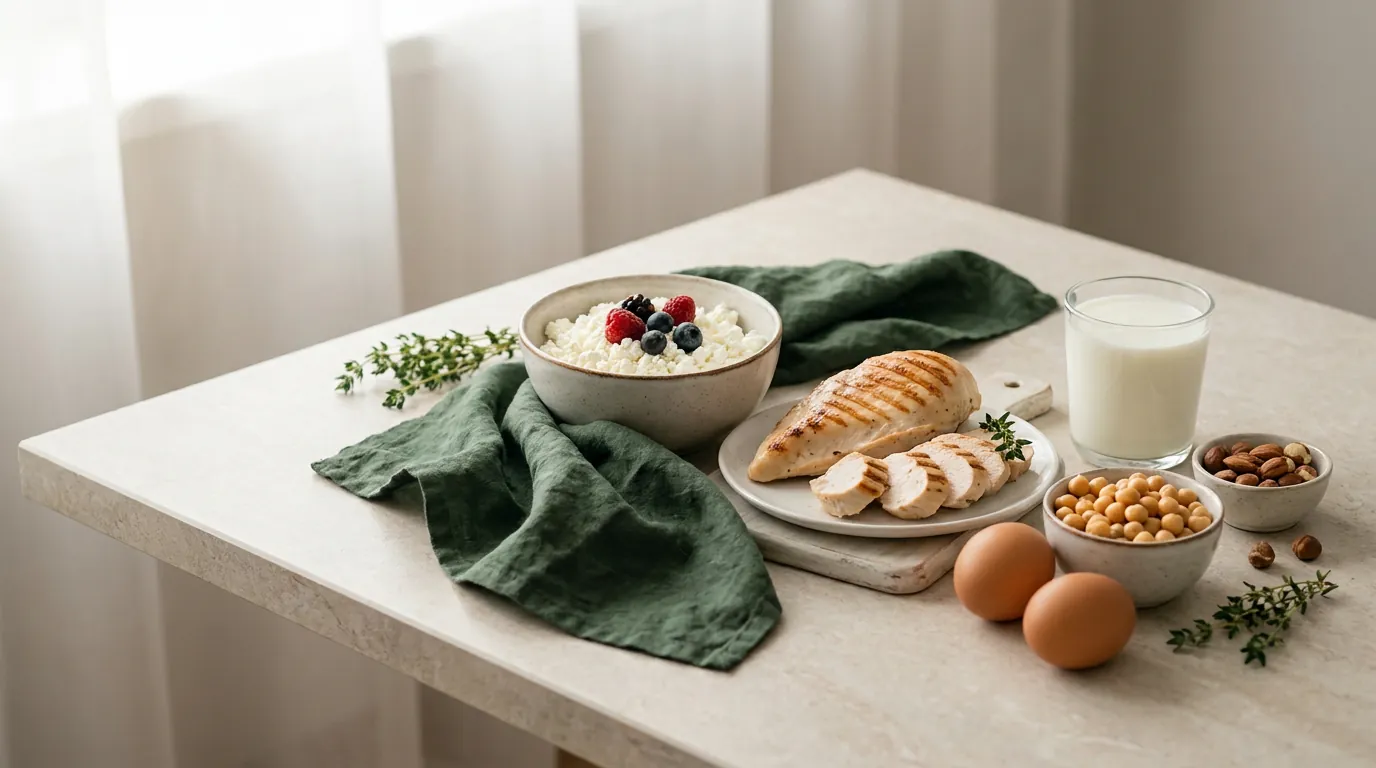
Because the target is per kilogram, the main difference between a woman and a man is body weight: a 60 kg woman who trains needs about 84-120 g a day, an 80 kg man about 112-160 g. Without training, at maintenance, that's 50 g and 66 g. In a calorie deficit the number goes up. The protein per kg calculator gives your own number by goal; below are tables by weight and what it looks like in real food.
Where "0.36 grams per pound" comes from
"Protein: 0.36 grams per pound." You've seen this everywhere. It's about 0.8 g per kg, and it isn't made up: Europe's adult requirement is 0.83 g per kg a day, from that same EFSA opinion. For a 175-pound (79 kg) person that's about 66 grams a day.
But that's the number for an adult who isn't training and just wants to hold their weight. If you work out, diet or try to build muscle, you need more, and that comes from different research. Here's what it says.
What the research actually says
Our calculator takes protein from three sources, depending on your goal and whether you train.
- Not training, holding your weight: 0.83 g/kg (0.38 g per pound), the EFSA adult requirement.
- Not training, losing weight: 1.2 g/kg (about 0.55 g per pound). The review by Leidy HJ et al., American Journal of Clinical Nutrition, 2015 points to 1.2-1.6 g/kg for weight loss; the calculator uses the low end.
- Training (for us that starts at light activity, 1-3 workouts a week): 1.4-2.0 g/kg from ISSN. Inside that range the calculator uses 1.4 for maintenance, 1.6 for a gain, 1.8 for a cut and 2.0 for recomposition. The exact numbers inside the ranges are our own pick.
The calculator doesn't go above 2.0 g/kg. ISSN also mentions 2.3-3.1 g/kg, but that's for resistance-trained people in a hard deficit trying to keep every bit of muscle. Most people don't need that.
For that 175-pound person trying to lose weight, that's about 143 grams a day if they train and 95 if they don't.
In the same Leidy review, short, tightly controlled weight-loss studies on higher protein showed more fat lost, more muscle kept and a little more fullness after meals. The authors call the fullness effect modest.

How much protein a woman and a man need: table by weight
These numbers come from the same engine that runs the protein calculator on this site, not from eyeballing it. First, if you train:
| Weight | Weight loss | Maintenance | Muscle gain | Recomposition |
|---|---|---|---|---|
| 50 kg | 90 g | 70 g | 80 g | 100 g |
| 60 kg | 108 g | 84 g | 96 g | 120 g |
| 70 kg | 126 g | 98 g | 112 g | 140 g |
| 80 kg | 144 g | 112 g | 128 g | 160 g |
| 90 kg | 162 g | 126 g | 144 g | 180 g |
| 100 kg | 180 g | 140 g | 160 g | 200 g |
| 110 kg | 198 g | 154 g | 176 g | 220 g |
Woman, 30, 165 cm, moderate activity, so she trains. Protein per kg: 1.8 for weight loss, 1.4 for maintenance, 1.6 for gain, 2.0 for recomposition, never more than 35% of calories. Worked out with the protein calculator.
If you don't train, the numbers are much lower:
| Weight | Weight loss | Maintenance | Muscle gain | Recomposition |
|---|---|---|---|---|
| 50 kg | 60 g | 42 g | 70 g | 70 g |
| 60 kg | 72 g | 50 g | 84 g | 84 g |
| 70 kg | 84 g | 58 g | 98 g | 98 g |
| 80 kg | 96 g | 66 g | 112 g | 112 g |
| 90 kg | 108 g | 75 g | 126 g | 126 g |
| 100 kg | 120 g | 83 g | 140 g | 140 g |
| 110 kg | 132 g | 91 g | 154 g | 154 g |
Woman, 30, 165 cm, sedentary, so no training. Protein per kg: 1.2 for weight loss, 0.83 for maintenance, 1.4 for gain and recomposition. Worked out with the protein calculator.
For men the grams are the same: in the calculator protein depends on weight, goal and activity, while sex, height and age barely move it. The one difference is that protein never drops below 10% of calories, so a 50 kg man who doesn't train gets 44 g at maintenance instead of 42. Calorie targets are different, all of those matter there; the full picture with calories, fat and carbs is in daily macro requirements.
If you're thinking in pounds: 70 kg is about 154 lbs, 80 kg about 176, 90 kg about 200. The calculator uses your current weight. With a lot of extra weight that can overstate your need, but we haven't found a checked rule for adjusting it, so the calculator caps protein at 2.0 g per kg and at 35% of your daily calories, the upper limit in the US Institute of Medicine's Dietary Reference Intakes, 2005.
If you're trying to build muscle, protein alone won't do it: you also need a small calorie surplus. How much to eat a day and how fast to expect the scale to move is what the calorie surplus calculator works out. It uses the same 1.6 g per kilogram as the "Muscle gain" column in the first table.
Why protein helps on a cut
If you're losing weight and want to pick one thing to watch, watch protein. Here's why. (If you want the whole split for a cut rather than just protein, that's here: how to calculate macros for weight loss.)
Muscle protection. In a calorie deficit your body loses some muscle along with fat. The Leidy review pooled meta-analyses: higher-protein diets kept more lean mass than normal-protein diets at the same calorie cut. ISSN also says people who train may need more protein in a deficit to keep their muscle.
Some fullness. In the same review, people felt fuller after higher-protein meals. To be fair, in those studies it barely changed how much they ate at the next meal. So protein helps; it isn't a miracle.
A day at 148 grams (nothing fancy)
Nothing exotic, nothing expensive. Take an 80 kg man who trains and wants to lose weight: the calculator gives him 144 g of protein. Protein per food below is from USDA FoodData Central (SR Legacy data).
| Meal | On the plate | Protein |
|---|---|---|
| Morning | Three large eggs, about 150 g (12.6 g protein per 100 g) | about 19 g |
| Lunch | 200 g of cooked chicken breast (about 62 g protein, 31 g per 100 g roasted) with buckwheat from 80 g dry groats (about 9 g more) | about 71 g |
| Snack | 150 g of plain Greek yogurt and 30 g of almonds (about 15 and 6 g) | about 21 g |
| Dinner | 150 g of baked pink salmon with vegetables | about 37 g |
Total: roughly 148 grams. No supplements, no protein powder, no weird foods. Just regular stuff from the grocery store.
Spreading it across meals works better than one huge dinner. ISSN suggests servings of about 0.25 g per kg of bodyweight, or 20-40 g, every 3-4 hours. The Leidy review lands in a similar place, at least 25-30 g per meal.
Can you get there without meat?
Yes, with two caveats nobody mentions.
First, legumes have less protein than people assume. Cooked lentils are about 9 grams per 100 grams, per USDA. To get 40 grams of protein you're eating close to a pound of them. Dry weights in nutrition tables look much better than what actually lands on your plate.
Second, plant protein often lacks one or more essential amino acids, and in the studies ISSN reviews, animal and dairy protein led to more muscle growth with training than plant protein. The standard fix is combining sources, beans with grains, and leaning on eggs, Greek yogurt and cottage cheese if you eat dairy.
Practical version: if you're plant-based, keep your sources varied and don't sit at the very bottom of your range.
The tracking problem
Here's what trips people up. You eat what feels like plenty of protein: meat at lunch, eggs at breakfast, yogurt as a snack. Feels like you're doing great.
The issue is that it's invisible. A bowl of soup with a little chicken in it, a sandwich, a salad with a few chicken strips: they all feel protein-rich, and they can still leave you well short of your number.
That's where logging helps. With the CalCash bot you just say what you ate in a chat and see the protein number right there. When it shows "Protein: 45g out of 140g target" by lunchtime, you know dinner needs to be serious. Without a tracker you'd just guess and fall short again.
Don't overthink it
A simple rule: every meal should have a solid chunk of protein. Meat, fish, eggs, Greek yogurt, cottage cheese, beans if you're plant-based. If you look at your plate and there's nothing from that list, fix it. That's a common rule of thumb, not a number from a study, but it fits the ISSN advice of 20-40 g servings.
You don't need to weigh your chicken to the gram. You don't need to hit exactly 140 or 150 every single day. Get close. Consistently. That's what matters.
And if you're not sure where you stand, track for just one week. Not forever, one week. You'll learn more about your protein intake in seven days of logging than in a year of guessing.

 Reminders
 Water and weight