You can count calories without a food scale. Estimate portions with your hand — a palm of meat, a fist of rice or pasta, a thumb of oil or nuts — and a tablespoon: one tablespoon of oil is about 14 g and 120 calories, per USDA data. You'll be less accurate than someone weighing every gram, but for losing weight that's usually plenty. Logging every day roughly beats logging perfectly for three days and then quitting.
Why people quit counting calories
The usual story goes like this. Someone installs a typical calorie counting app and logs breakfast. Searching "oatmeal" gets dozens of variations: steel cut, rolled, instant, with brown sugar, with milk, one brand, another brand. Which one is it? It's oatmeal. From a bag.
Homemade soup is even worse. You're supposed to break it down into every ingredient, weigh each one, create a "recipe" in the app. For soup you make by feel.
A week or two later the app gets closed and never opened again.
And it isn't laziness. Plenty of people who quit track their workouts, their spending, their sleep. But spending 10-15 minutes per meal on data entry? That's not self-care. That's a part-time job.
People quit because the tools are painful, not because they're lazy
Traditional calorie counting apps were designed back when nobody had a better idea. Search a database, pick from a list, enter grams. Three steps that feel like thirty.
Think about it. Three meals a day, maybe a snack or two. If each entry takes 3-5 minutes of searching and selecting, that's 15-25 minutes daily just on food logging. In a week, that's almost two hours. On what? On typing "grilled chicken breast 6 oz" into a search bar.
Any system with that much friction eventually falls over. Not because you failed it — because it was designed badly. There's gotta be a better way. And honestly, there is.
The hand method — low-tech but legit
No food scale? No problem. This is how people have estimated portions without equipment for years.
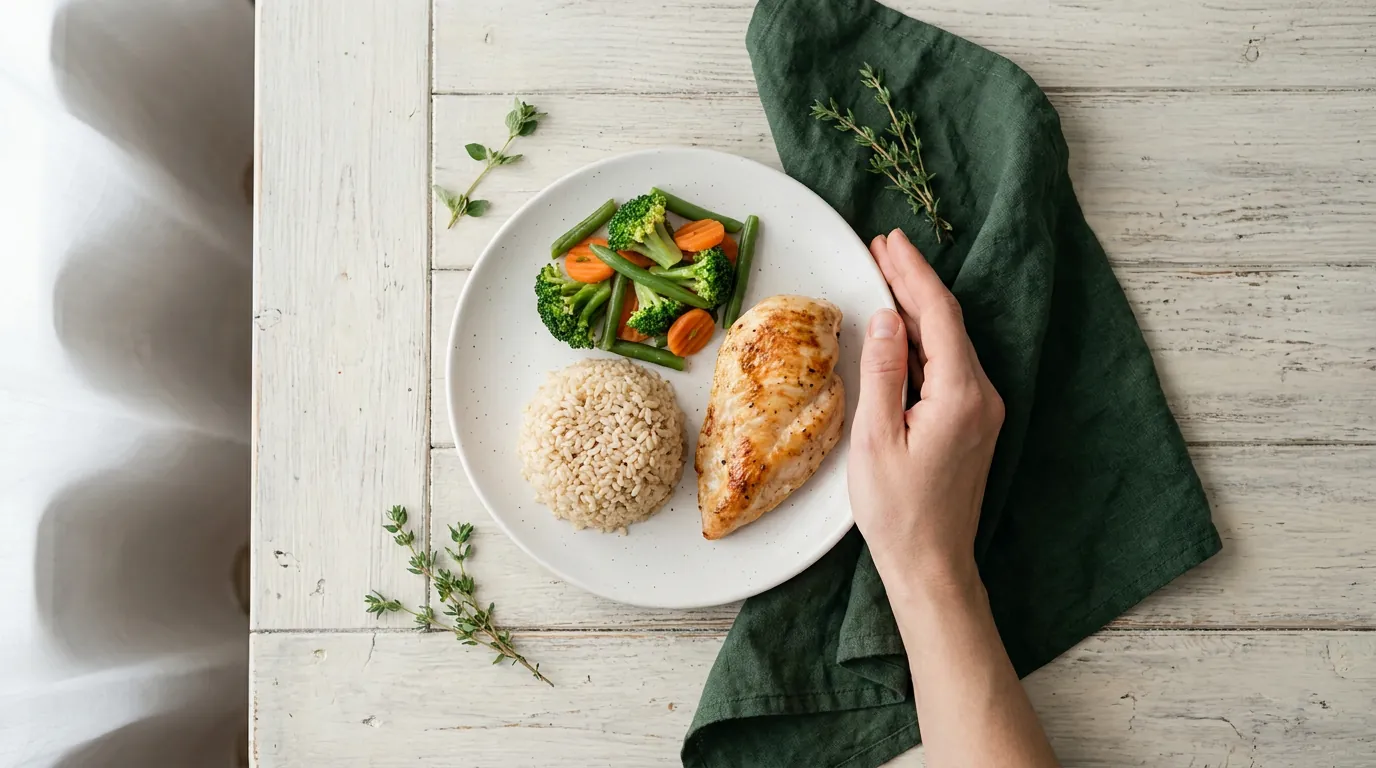
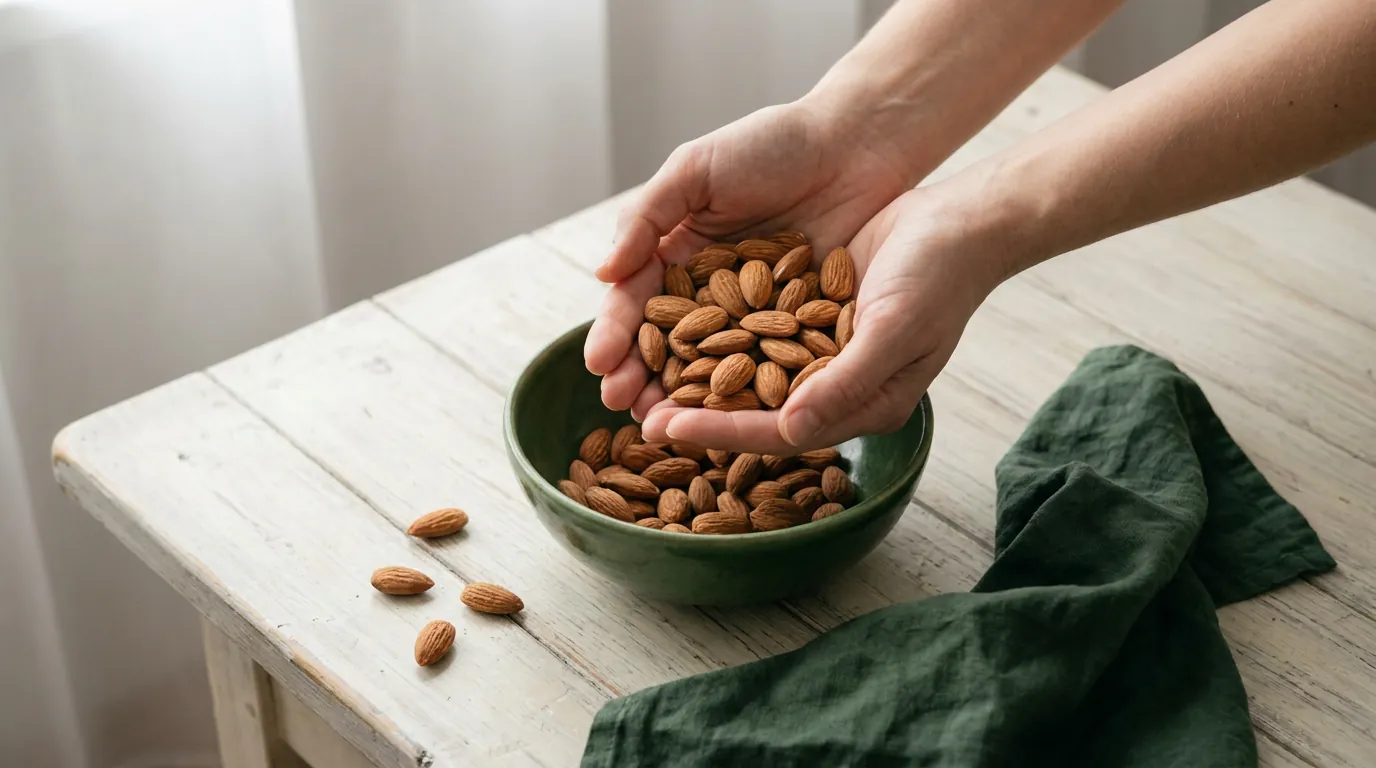
Your palm — that's roughly a serving of meat or fish. A fist — a serving of cooked grains or rice. Your thumb — a serving of fat like butter, oil, or nut butter. Two fists of vegetables — what should be on your plate at minimum.
These are common rules of thumb, not measurements: if you want to know what your palm holds in grams, check it on a scale once. Is this perfectly accurate? Nope, it's a lot rougher than weighing. And y'know what? For most people, that's plenty. You're not prepping for a bodybuilding show. You're trying to eat a reasonable amount of food and not gain weight.
There's a neat logic to it, too: your hand scales with your body. A bigger person has a bigger palm and therefore a bigger portion, which is roughly how it should work.
Plenty of people get a long way on the hand method and a plain food log, with no scale in sight. No weighing, no measuring cups, no agonizing over whether the rice was 140 or 160 grams. Just rough portions, consistent tracking, done.
Cups and spoons — for what your hand can't measure
Hands are good for solid chunks. They're useless for liquids, powders and anything you pour, and that's where a regular tablespoon and measuring cup earn their keep.
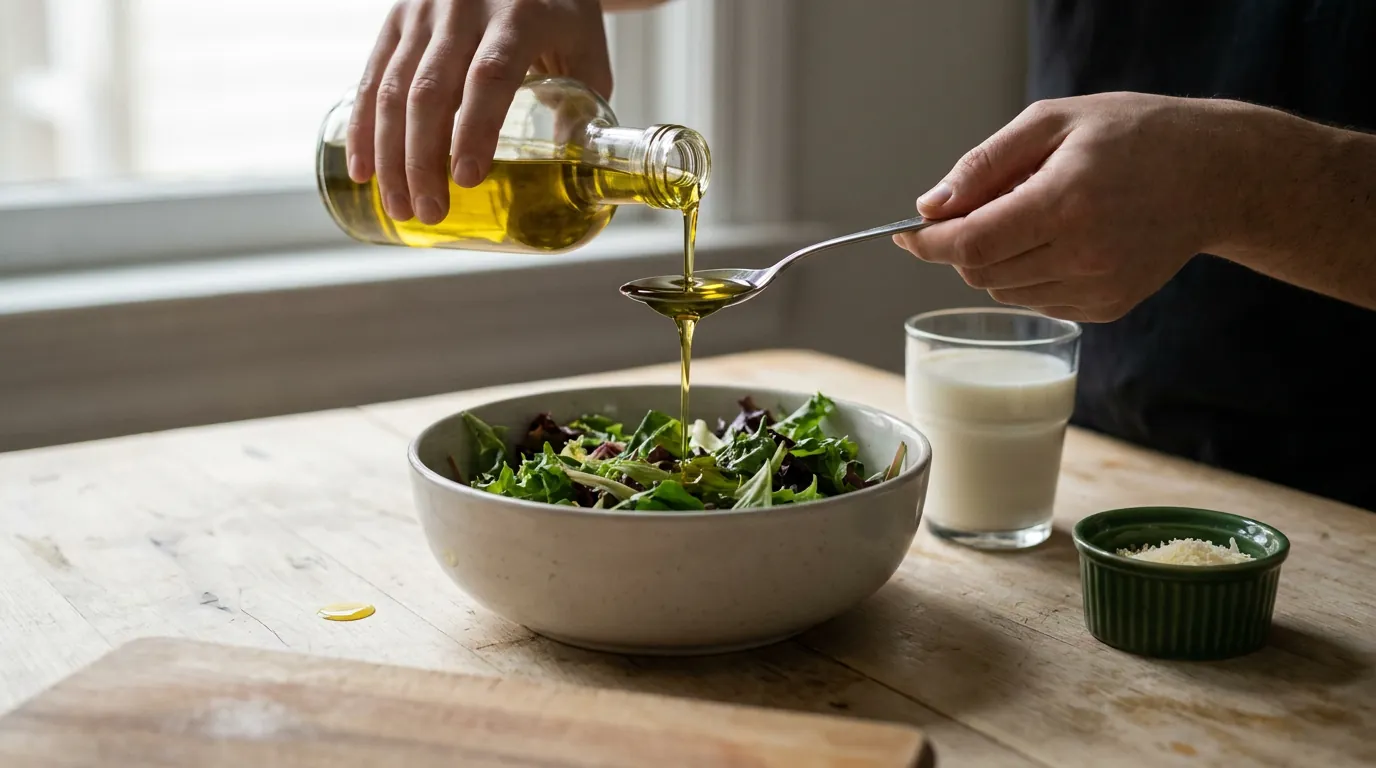
- A tablespoon of oil is roughly 120 calories, per USDA FoodData Central (olive oil: 13.5 g and 119 calories). This is the single most underestimated item in most kitchens — "a little drizzle" on a salad is routinely two or three spoons
- A cup of dry rice or pasta is several servings, not one
- Ladles come in all sizes: measure yours once with a measuring cup
The point isn't to measure everything forever. The point is to measure the things you eat constantly, once. Measure your usual bowl of rice one time and you know it for life.
Why perfect accuracy is a trap
This needs to be said, because it's such a common trap: people obsessing over exact gram counts. Buying three different kitchen scales. Panicking because their banana weighed 118 grams instead of 110 and what does that mean for their macros??
Breathe.
Here's the real math. Say your estimates are off by a fifth either way. Sounds bad? But here's the thing — if before this you weren't counting at all and were regularly eating well over your burn, even sloppy counting changes the game completely.
Take an example. Someone believes they eat "around 2000" calories, which is roughly what the calorie calculator gives them for maintenance. Two honest weeks of logging show 2,650 a day. That gap of 650 calories a day is exactly the kind of thing even rough tracking catches in the first week. It's an illustration, not anyone's real story.
And for what it's worth, a scale doesn't buy you certainty either. The calorie content of the same food varies between batches, and databases filled in by users come with typos and all. "Precise" counting is less precise than it looks. Where each app's numbers actually come from is worth knowing before you trust them — a look at calorie counter apps.
Voice logging changed everything
With the CalCash bot you just say what you ate into a Telegram chat. "Had a bowl of soup with bread and sour cream." That's it. Done. It gets broken into ingredients, portions get estimated, macros get calculated. It's a food diary that lives inside Telegram, so there is no separate app to open.
Five seconds per meal. Maybe six if you talk slow.
No searching databases. No scrolling through 47 types of oatmeal. No creating recipes for soup. Just say it like you'd tell a friend what you had for lunch.
Running late? Text "coffee and a banana" on the way to the car. Two seconds. Logged. At a restaurant, snap a photo of the plate and it handles the rest.
Is it as precise as weighing everything on a scale? No — portions are estimated, same as with the hand method. But it's close enough, and because it's quick, you actually do it every single day. That consistency matters way more than precision.
Where rough counting goes wrong
The hand method holds up well for plain food and much worse for four things. Know them in advance, because these are what quietly eat your calorie deficit.
Oil and dressings. Invisible calories in their purest form — a spoon in the pan and a spoon on the salad is about 240 calories by USDA figures, and you never see them on the plate.
Sauces and drinks with sugar in them. Mayo, ketchup, juice, a latte. Small volume, big numbers.
Mixed dishes. Casseroles, fried rice, shawarma, anything baked at home. You can't see how much butter and sugar went in, so the spread is enormous. If it's your own recipe, you can work it out properly once: how to calculate calories in homemade food.
Alcohol. Easy to forget when logging, and it counts like everything else.
Photo logging has the same weak spots, for the same reason: a camera can't see the oil either. How big the error gets, and where, is broken down in how accurate AI calorie counters from photos are.
Simple fix: for anything liquid, fatty or mixed, estimate high. If you're going to be wrong, be wrong in the direction that doesn't flatter you. Restaurants work the same way, with a few extra traps of their own: how to count calories when eating out.
How to count calories and actually keep going
Before you start, it helps to know roughly where you're aiming: how many calories you need a day has tables for women and men by weight.
Here's a three-week plan. Nothing fancy.
Week one — just write down what you eat. Don't count anything. Don't look up calories. Don't restrict. The only goal is building the habit of recording. Eat your normal food. Just log it — and if that habit is the part that keeps collapsing for you, it has its own set of traps: how to keep a food diary.
Week two — now look at the numbers. Where are you overdoing it? Often it's cooking oil (healthy fat, sure, but every tablespoon is about 120 calories, per USDA) and portion sizes: "a bowl of rice" can easily be two servings.
Week three — fix the biggest problem areas. Not everything, just the one or two things that make the most difference. For example: measure oil with a spoon instead of pouring, and use a slightly smaller bowl for rice. Same food, just less of it, and your log will show how much that saves.
Don't aim for perfection from day one. Sloppy daily tracking beats perfect counting for two days followed by nothing. And if you want protein, fat and carbs on top of the calorie number, start from daily macro requirements. The best calorie counting method is the one you'll actually stick with. For a home dish you cook often, weigh the ingredients once and run it through the recipe calorie calculator: after that, one per-100 g number is all you need.
The thing nobody tells you about counting calories
After about a month of consistent tracking, something weird happens. You stop needing to track as much. You develop an internal sense for what's on the plate, because you've seen the numbers enough times.
It's like learning to drive. At first you think about every action. After a while, it's automatic. Many people end up logging less on weekdays, when meals repeat, and keep logging weekends, because that's where things get unpredictable.
Track to learn. Then coast on what you've learned. That's the whole system.
 Reminders
 Water and weight