To calculate calories in homemade food, add up the calories, protein, fat and carbs of every raw ingredient, oil included, then weigh the finished dish and divide the total by the cooked weight. That gives you the numbers per gram: multiply by 100 for a per-100 g figure, or by the weight of your portion for what's on your plate. Cooking water adds no calories, only weight, which is why rice and pasta are always counted by their dry weight.
The whole formula in one line
Calories per 100 g = total of the raw ingredients / cooked weight × 100.
That's it. Everything else in this article is a special case of that line: what to do with water, with oil, with soup, and with burgers that shrink in the pan while you watch.
Why divide by the cooked weight and not the raw one? Because the dish changes weight between the pot and the plate. Rice soaks up water and gets several times heavier. Meat and vegetables go the other way, losing water and getting lighter. The calories don't go anywhere. Whatever was in the raw ingredients is still in the pot. The only thing that changes is how many grams they're spread across.
So the rule is: weigh the raw ingredients before cooking and the finished dish after. Two weigh-ins are enough to get the macros for any recipe you make. No scale at all? An honest estimate by eye works too, and that has its own guide: how to count calories without a scale.
A worked example: chicken and rice pilaf
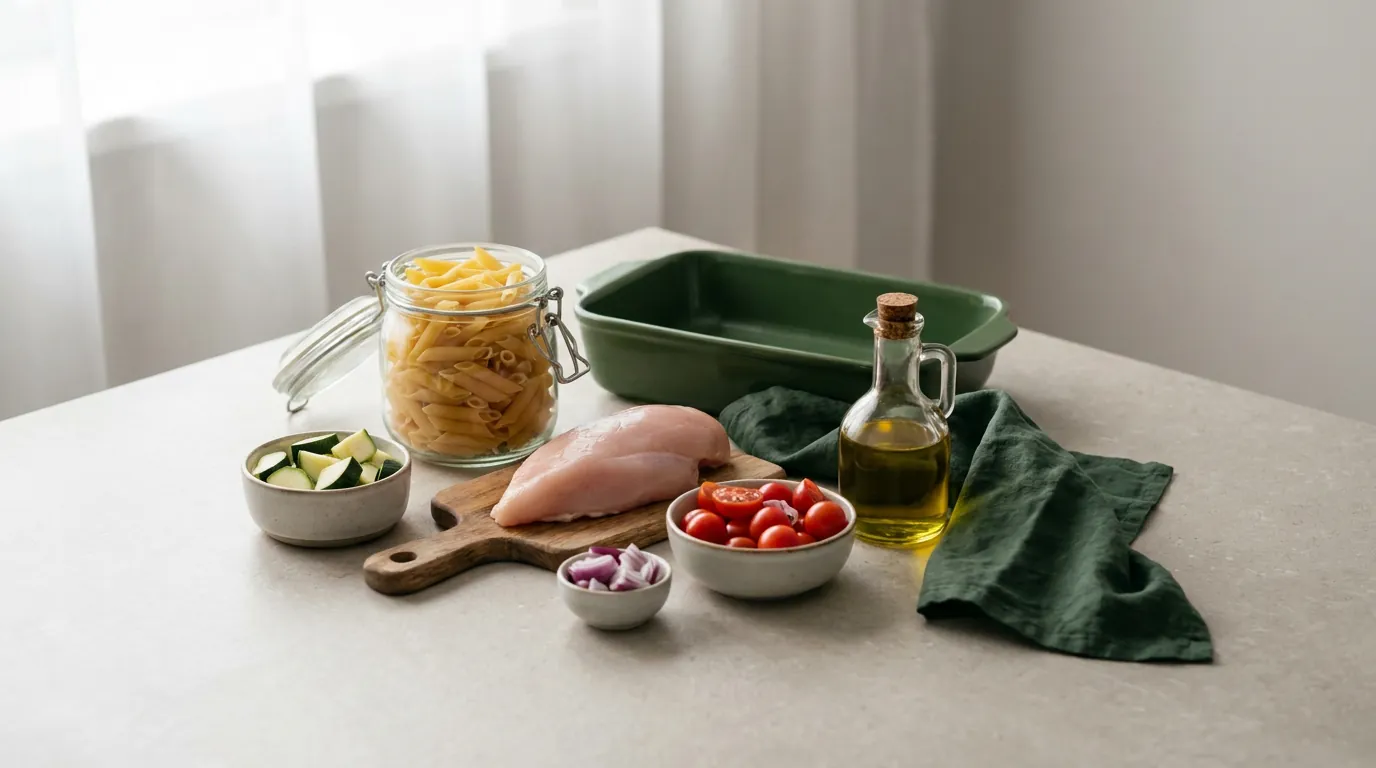
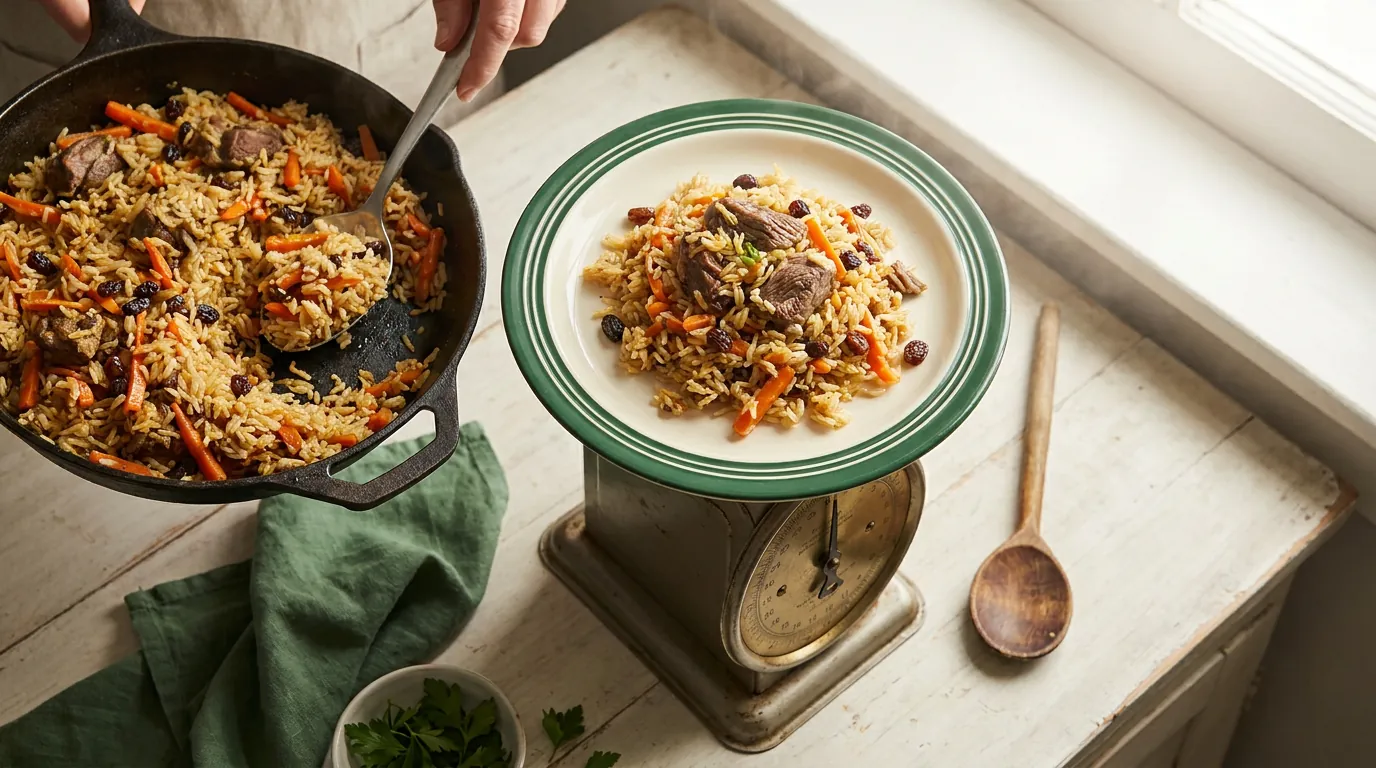
Let's take an ordinary one-pan chicken pilaf. The per-100 g numbers for each ingredient come from the US Department of Agriculture database, USDA FoodData Central, the same one the CalCash bot uses to fine-tune calorie counts. Each row shows the database entry and its FDC number, so you can look up the same line yourself.
| Ingredient (FDC entry) | Raw, g | kcal | Protein, g | Fat, g | Carbs, g |
|---|---|---|---|---|---|
| White long-grain rice, dry (Rice, white, long-grain, regular, raw, unenriched; 169756) | 300 | 1095 | 21.4 | 2.0 | 240.0 |
| Skinless chicken thigh, raw (Chicken, broilers or fryers, dark meat, thigh, meat only, raw; 173627) | 500 | 605 | 98.5 | 20.6 | 0 |
| Carrots, raw (Carrots, raw; 170393) | 200 | 82 | 1.9 | 0.5 | 19.2 |
| Onion, raw (Onions, raw; 170000) | 150 | 60 | 1.6 | 0.1 | 14.0 |
| Sunflower oil (Oil, sunflower, linoleic, approx. 65%; 171025) | 40 | 354 | 0 | 40.0 | 0 |
| Total | 1190 | 2196 | 123.4 | 63.2 | 273.2 |
| Per 100 g of cooked pilaf (cooked weight 1600 g) | 100 | 137 | 7.7 | 4.0 | 17.1 |
| One 350 g serving | 350 | 480 | 27.0 | 13.8 | 59.8 |
The cooked weight is just an example. Yours will be different, because it depends on how much water went in and how much boiled off. That's why you weigh it rather than guess it.
The steps:
- Weigh every raw ingredient and write it down. The oil too. That's the most common gap.
- Work out each ingredient: per-100 g number × weight / 100.
- Add everything up into a total.
- Weigh the empty pan or pot before you start. After cooking, weigh it with the food and subtract the pan.
- Divide the total by the cooked weight and multiply by 100.
Look at the oil. 40 g, roughly three tablespoons, brought 354 of the 2196 calories, about a sixth of the whole pan. And 40 of the 63 grams of fat came out of the bottle, not the chicken.
Rice, pasta, oats: dry or cooked?
This is where people get tangled up most often, and it's an expensive mistake.
The same FDC database has two entries for the same white long-grain rice. Dry: 365 kcal per 100 g (entry 169756). Cooked without salt: 130 kcal per 100 g (entry 169757). Same rice. The only difference is the water it absorbed.
Weigh the rice dry but use the "cooked" number, and you undercount it by almost three times. Weigh it cooked and use the "dry" number, and you overcount. The rule is simple: log it the way you weighed it. Weighed it dry, use the dry entry. The label on the bag usually gives calories for the dry product too.
Dry weight is also more reliable because everyone's cooked rice is different. Some people cook it fluffy, some cook it nearly into porridge, so 100 g of cooked rice holds a different amount of actual rice from one kitchen to the next. 100 g of dry rice is the same everywhere.
Soup and stock: what to do with the liquid
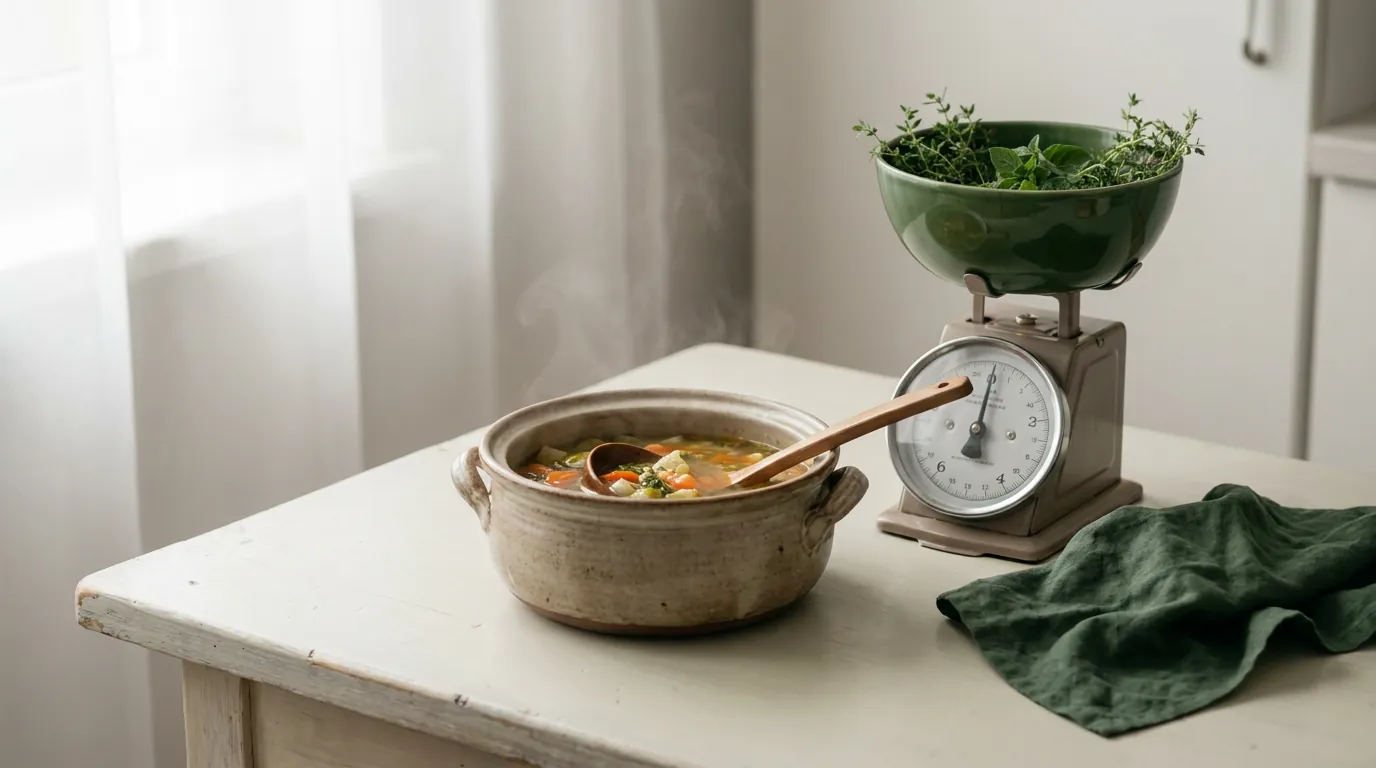
Soup uses the same formula; water just happens to be the heaviest ingredient. Add up everything that went into the pot: meat, potatoes, beans or grains, the oil you sautéed the onions in, cream if it goes into the whole pot. Skip the water, it has no calories. Then weigh the finished soup without the pot and divide.
A few places where soup fools you:
- Meat on the bone. If you make stock with bones and fish them out later, count the meat that actually ended up in the soup. The bones don't reach your bowl.
- Fat on top. If you skim fat off the stock, some calories leave with it. Nobody can say how many by eye, so it's simpler to count everything as it went in. Your number comes out a bit high, which is the safe direction to be wrong in.
- Toppings in the bowl. Sour cream, cheese or bread added to your own serving get logged separately. They aren't part of the pot.
One more thing: soup rarely gets served evenly. The top is thinner, the bottom is thicker. If you want to be closer, stir before you ladle your serving.
Oil, sauce, breading: where the calories hide
In home cooking the calories usually hide not in the main ingredient but in what you add along the way. You can't see them on the plate, so they don't get logged.
Frying oil. Some of it stays in the pan, true. But nobody knows exactly how much. The honest move is to count all the oil you poured. If you want to be more precise, weigh the bottle before and after: the difference is what went into the dish.
Sauces and dressings. Mayo in a salad, cream in a pasta, sour cream in a stew. Anything that went into the shared pot counts toward the total. Anything you added on your own plate is a separate entry.
Breading. The flour, egg and breadcrumbs you rolled the cutlets in are food too. Weigh them before breading and what's left in the bowl after, and count the difference.
Sugar and honey. In baking and marinades they get forgotten almost every time.
Burgers, meatballs and baking: shrinkage
Patties lose weight in the pan. Mostly it's water, with a little fat left behind in the pan. A cake comes out of the oven lighter than the batter that went in.
The classic mistake here: taking the per-100 g number for raw ground meat and multiplying it by the weight of the cooked patty. That comes out too low, because the water left but nearly all the calories stayed, so every gram of cooked patty holds more of them.
The formula protects you from this on its own. Add up everything that went into the mix: meat, bread, egg, onion, the oil in the pan. Cook it, weigh all the patties together, and divide. You don't need to know a shrinkage percentage; the scale tells you.
Baking works the same way: the total of everything in the recipe divided by the weight of the finished cake once it's cooled. And if you bake the same recipe regularly, one calculation is enough.
How to stop recalculating the same recipe
Nobody is going to redo the pilaf table every Sunday. You don't have to.
If you cook the same recipe over and over, work it out once and keep the result: the numbers per 100 g. Put "pilaf: 137 kcal, P 7.7, F 4.0, C 17.1 per 100 g" in your notes, and from then on you only weigh your serving. Change the recipe, say less oil or beef instead of chicken, and recalculate.
For food you cook differently each time or just don't want to weigh, there's a simpler route. I stopped doing home cooking by spreadsheet a long time ago: I text or voice-message a Telegram bot "chicken pilaf, a big plate", or just send a photo of it. It's a bot that counts calories from photos and voice: free, it estimates the portion and macros, and fine-tunes calories against the same USDA database. If you know what's in the dish better than the photo shows, add a line of text saying what's inside.
The point of all this math is knowing what you ate in a day and comparing it with your target. If you don't have a target yet, the macro calculator will show how much protein, fat and carbs you need. And to keep logging past the first week, see how to keep a food diary.
 Reminders
 Water and weight