To lose weight, eat less than your maintenance calories: the CalCash calculator takes off 250, 500 or 750 kcal, but never more than 20% of maintenance. Maintenance comes from the Mifflin-St Jeor equation (1990): basal metabolism times an activity multiplier. For example, a 30-year-old woman, 165 cm, 70 kg, lightly active, maintains on about 1,953 kcal a day and on a gentle 250 kcal deficit, about 13%, eats 1,703. After that, the job is logging everything you eat for a week.

This isn't another explanation of what a calorie deficit is — the explanation, with formulas, numbers and tables, lives here: what a calorie deficit is and how to calculate yours. What follows is a plan for the first seven days: what to do today, what to eat through the week, how to track it, and what to do when the scale stalls.
The plan assumes a healthy adult who wants to lose weight at a sane pace. It isn't medical advice, and there's a section at the end on who shouldn't start this way.
Day 0 — get three numbers on paper
It starts with numbers, not food. Open the calorie deficit calculator, enter sex, age, height, weight and activity level, pick a pace, and write down:
- Your burn (TDEE) — what your body spends in a day
- Your deficit target — what to eat each day
- Your protein target — in a deficit it's what keeps muscle on you
For week one pick the mild or moderate pace. Aggressive looks appealing right up until Thursday.
Then weigh yourself in the morning, before eating, and write that down too. It's your starting point, and you'll come back to it on Sunday.
That's all day zero needs. No "new life starting Monday," no bulk-buying rice, no clearing out the fridge.
Days 1-2 — change nothing, just log it
The most common week-one mistake is changing everything at once: food, schedule and training. That lasts about three days.
For the first two days, eat exactly what you normally eat. The only job is logging all of it — the coffee with milk, the oil in the pan, the two sweets you took from a colleague's desk.
Logging has to take seconds or you'll quit. That's why we built a Telegram bot for it: you message what you ate — by text, voice note or a photo of the plate — and it breaks it down into calories and macros. It's a bot that counts calories from a photo and voice, and there's no separate app to install.
By the end of day two you have something you didn't have before: an honest number for what you actually eat. Often it's higher than expected.

Day 3 — fit the food to the target
Now compare those two days with the target from the calculator. The gap is what needs to go.
Start with what doesn't fill you up:
- liquid calories: sweetened coffee, juice, soda, beer;
- sauces and cooking oil: a tablespoon of oil is about 119 kcal per USDA data, an easy cut nobody notices on the plate;
- autopilot snacking: cookies with tea, nuts in front of a show.
If the gap is big — say you eat 2800 and your target is 2000 — don't jump straight down. Take off a little every day or two and arrive over a week or so. That's common practice, not a figure from a study. A sudden drop almost always ends at the fridge in the evening.
Days 4-5 — how a plate gets built
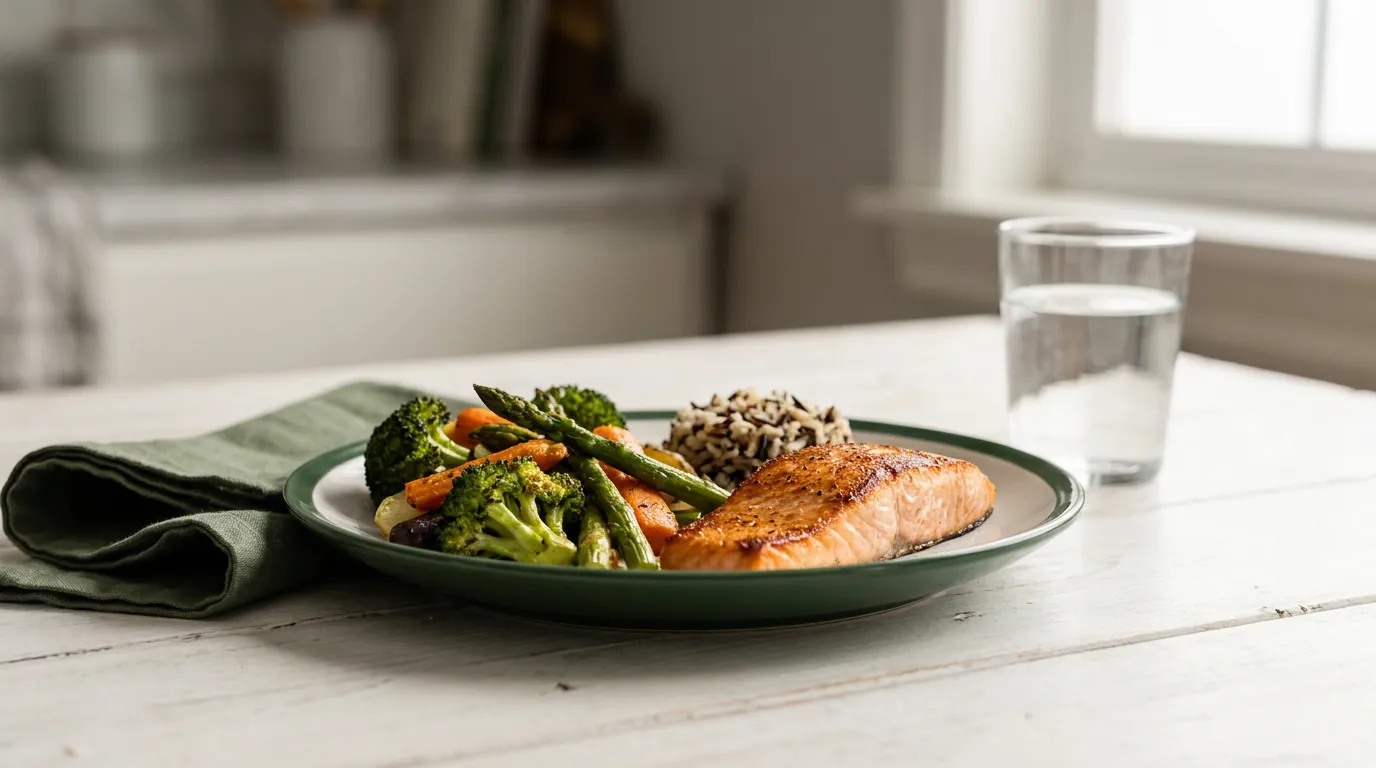
There's no seven-day menu with gram weights here. People eat differently, and someone else's menu gets abandoned by day three. Instead, here's the principle behind each meal. If you do want the numbers — how much protein, fat and carbs should land in a day — that's here: how to calculate macros for weight loss.
Protein at every meal. Meat, fish, eggs, dairy, beans. In the review by Leidy HJ et al., American Journal of Clinical Nutrition, 2015, higher-protein weight-loss diets kept more muscle and left people a little fuller after meals; the range it gives for weight loss is 1.2-1.6 g of protein per kg of body weight. For people who train, the International Society of Sports Nutrition Position Stand, 2017 puts the useful range at 1.4-2.0 g per kg of body weight a day, and notes a deficit may call for more.
Vegetables for volume. They cost almost nothing in calories but take up room on the plate and in your stomach — the cheapest way to feel fed in a deficit.
Carbs sized to the day. Training day or a lot of walking — keep the rice, pasta and bread. Desk day — a bit less. Cutting them out entirely isn't the point.
Fats, but measured. Oil, nuts, avocado all belong in the plan; they just need measuring rather than pouring. WHO guidance is to keep saturated fat under 10% of daily energy and to limit free sugars (WHO fact sheet "Healthy diet", checked 19.10.2026).
And water. Nothing magic about it. How much to drink is what the water intake calculator works out.
Don't delete the food you love. A chocolate bar that fits the target does far less damage than a month of bans followed by a blowout.
Days 6-7 — the weekend, where plans go to die
Five days on target, then Saturday: a restaurant, delivery, "it's fine, it's the weekend." Two days like that can swallow the whole week's deficit.

What helps:
- log the weekend exactly like the weekdays, even when you don't like the numbers;
- leave room before a restaurant — eat lighter during the day rather than starving until evening — and log the meal itself in parts: how to log a restaurant meal;
- judge the week as a whole. A big Saturday isn't a failure if Monday to Friday were under.
The goal for week one isn't seven perfect days. It's seven days with a log. Messy tracking every day beats perfect tracking for two days and silence after that. Keeping that log alive past week two is a skill of its own: how to keep a food diary.
End of the week — what to look at
Sunday morning, before eating, weigh yourself and look at the week as a whole.
Use the weekly average, not the daily readout: weight bounces around with water, salt, stress and last night's dinner. The calculator plans for about 0.25-0.5 kg (half a pound to a pound) a week, but week one can land on either side: early on weight often drops faster, partly from water. Don't get used to that pace.
Nothing moved and the log is honest? Take off a little more (studies don't give an exact step) and give next week a chance to work. If it sits still for two or three weeks, that's a plateau: check the log first and recalculate for your current weight, and the full list of causes is in why you're not losing weight on a calorie deficit. Cutting even harder is the worst option: the hunger grows and the scale still doesn't move.
Losing much faster than the calculator planned, and not just in week one? The deficit may be too steep. Eat a bit more. Faster isn't better: the CDC notes that people who lose gradually, about 1 to 2 pounds a week, are more likely to keep it off.
Who this plan isn't for
Honestly, not everyone.
If you're pregnant or breastfeeding, a teenager, have a history of disordered eating, or live with diabetes, kidney, liver or thyroid disease — or take medication that affects appetite or weight — don't start with a self-directed deficit. That needs a doctor who knows your history.
This text isn't a prescription from a doctor or a dietitian. If you have a chronic condition or any doubts, see a doctor first and the calculator second.
The short version for tomorrow
Get your target from the calorie deficit calculator, write down your weight, log food as-is for two days, fit the food to the target from day three, and don't drop the log on the weekend. If you want the theory behind it, that's in what a calorie deficit is.


 Reminders
 Water and weight